Governance and Training
Scheme governance overview
The investment and management of LGPS assets, the collection of employer and employee contributions and payment of pension benefits is the responsibility of individual LGPS administering authorities. There are 86 LGPS administering authorities in England and Wales.
At scheme level, the governance regime for LGPS administering authorities in England and Wales is set by the Ministry of Housing, Communities and Local Government (MHCLG).
LGPS administering authorities must also take account of guidance issued by the Pensions Regulator (TPR) and Pensions Ombudsman determinations.
Regulation 55 of the LGPS Regulations 2013 requires all administering authorities to publish a Governance Compliance Statement and explain any non-compliance. Each administering authority is subject to an annual external audit and must publish an audited financial statement and annual report by the relevant statutory deadlines.
The Scheme Advisory Board is established in legislation, with a statutory purpose to advise the Secretary of State and support the effective governance and administration of the LGPS. In doing so it helps MHCLG and administering authorities fulfil their statutory duties and obligations. The Board’s Secretariat, hosted within the Local Government Association (LGA), assists the Board to discharge its functions.
In 2023 the Board established the Compliance and Reporting Committee (CRC) as an additional committee of the board to:
- Provide support and guidance to administering authorities in delivering compliance and reporting
- Engage with regulators to clarify compliance requirements and encourage the integration and appropriate simplification of those requirements
- Seek to promote the development of clear, appropriate, meaningful and transparent reporting to stakeholders.
The Chair of the CRC also reports to Chartered Institute of Public Finance and Accounting (CIPFA)’s Public Finance Management Board (PFMB) to provide a direct link to CIPFA’s Board and Council. This is to ensure that the CRC’s work on governance is integrated into CIPFA’s own policy and technical work.
Preparing the Pension Fund Annual Report guidance
In March 2024, updated guidance, produced jointly by the CRC, CIPFA and MHCLG, for preparing the fund annual report was published on the Board’s guidance page.
The guidance applied to fund annual reports from 2023/2024 onwards, with compliance in the first year on a ‘best endeavours’ basis. Funds could exercise judgement on the application of this principle in instances where changes to the content would require disproportionate effort or cost. As this is the second year in which the guidance has been in effect, full compliance is expected. Compliance with the guidance has been assessed as part of the Scheme Annual Report data‑collection exercise, and a summary of the findings is set out below:
| Status | Fund account | Governance and training | Administration | KPIs | Net asset statement | Asset allocation | Manager analysis |
| Complete | 100% | 93% | 97% | 69% | 100% | 83% | 100% |
| Partial | 0% | 7% | 3% | 9% | 0% | 0% | 0% |
| Missing | 0% | 0% | 0% | 22% | 0% | 17% | 0% |
*KPI compliance was marked as ‘complete’ when more than 75 per cent of KPIs were reported, ‘partial’ when 50-75 per cent of KPIs were reported and ‘missing’ if less than 50 per cent were reported.
Governance and training compliance was marked as ‘partial’ if four or more of the following were missing: scheme member and employer representation, number of Pension Committee and Local Pension Board meetings, voting rights, meeting attendance, conflicts of interest policy, training and Board or Committee Annual Report. Funds would be marked as ‘missing’ if they did not include any of the above in their annual reports.
Administration compliance was marked as ‘partial’ if four or more of the following were missing: actives by administration function, member numbers, employer numbers, actions taken on communication policy, administration value for money statement, complaint and dispute resolution, and data improvement plan. Funds would be marked as ‘missing’ if they did not include any of the above in their annual reports.
Asset allocation compliance was marked as ‘missing’ if funds did not include a clear target and actual asset allocation with data labels.
75 (86 per cent) pension funds met the statutory deadline of publishing their annual reports by 01/12/2025. 42 pension funds shared their annual reports with the Scheme Advisory Board Secretariat, the rest were found through a search of fund and Council websites.
Number of pension committee and local pension board meetings reported
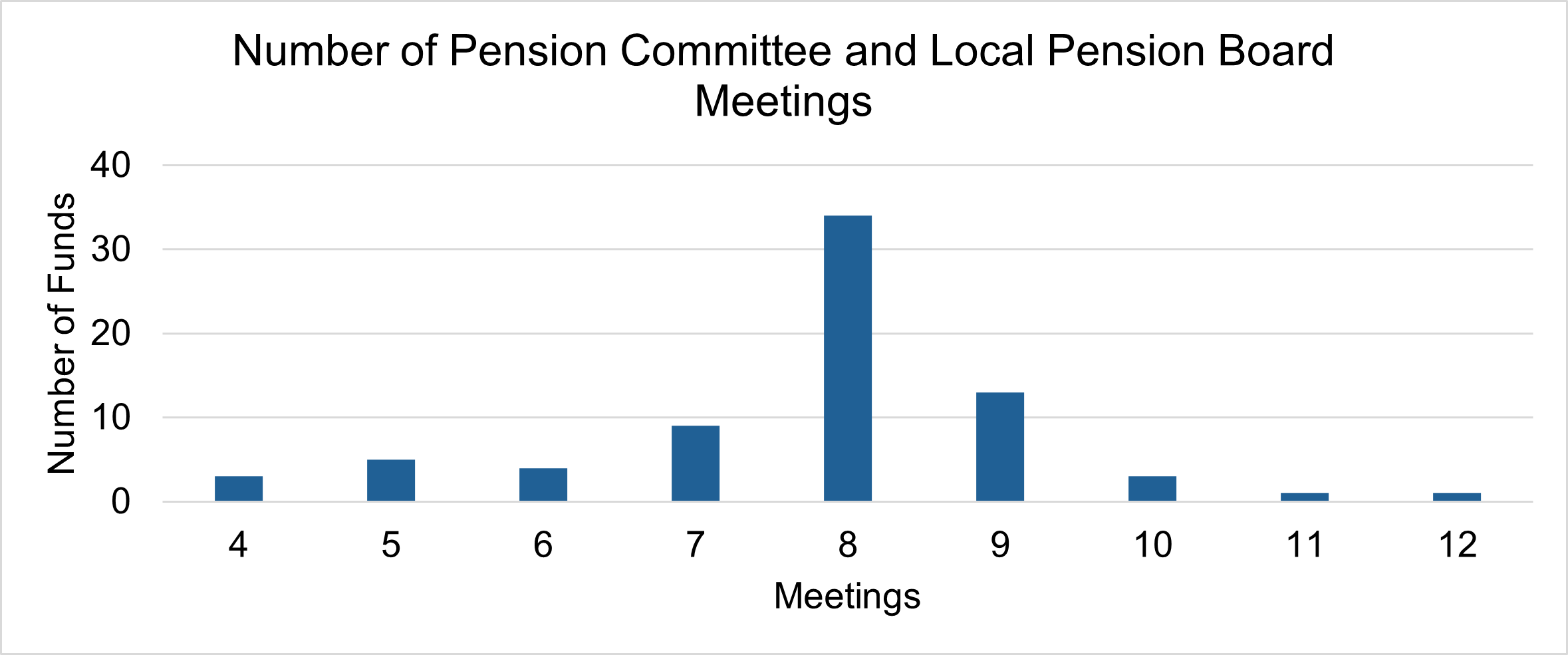
Seventy-three out of eighty-seven annual reports reported how many pension committee and local pension board meetings their fund held throughout the year. The average number was eight and ranged from four to twelve meetings.
Seventy-six pension funds (87 per cent) reported individual meeting attendance figures in their annual reports.
| Meeting attendance reported | Percent |
| Yes | 87% |
| No | 13% |
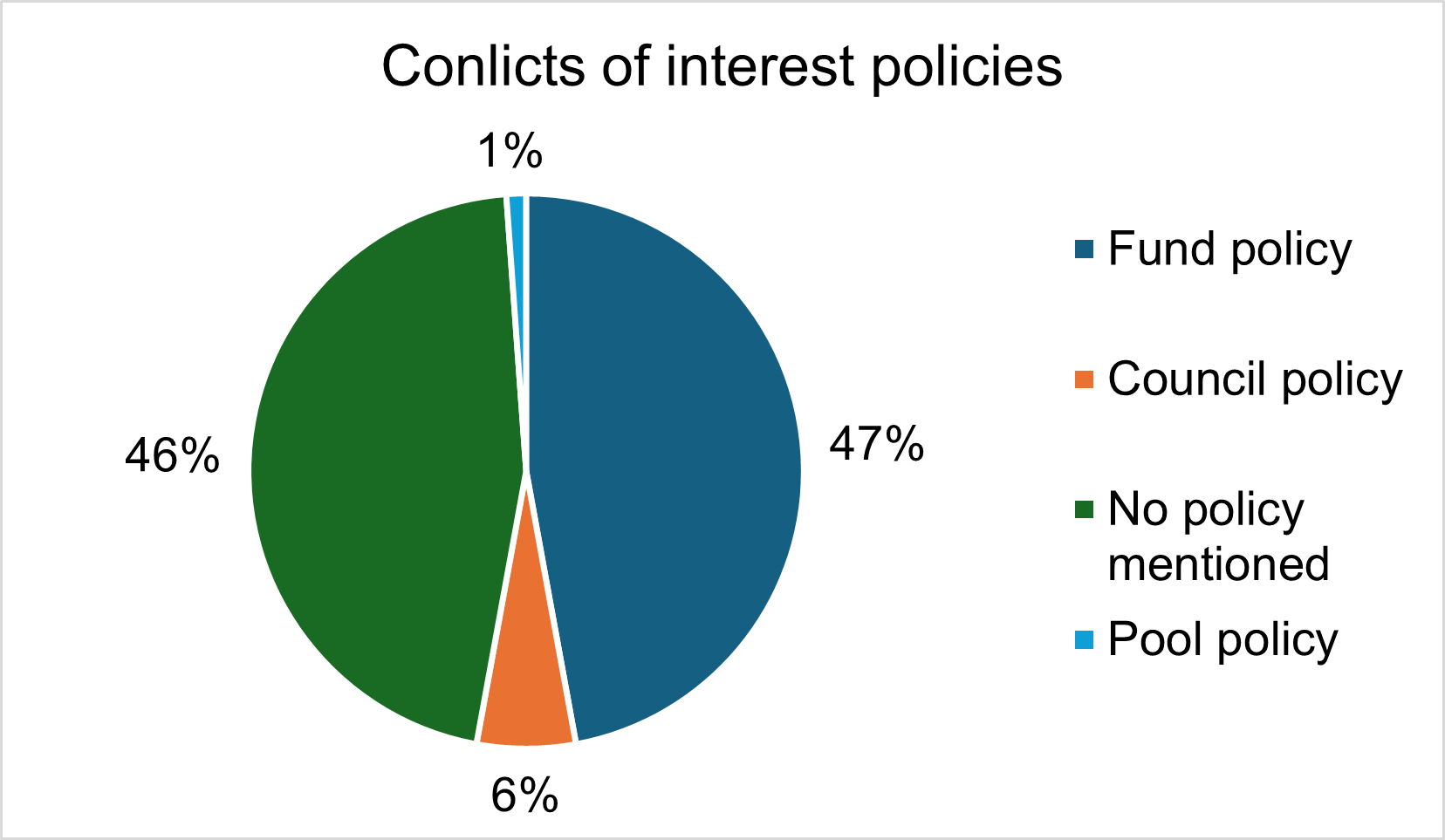
Where funds referenced conflicts of interest policies in their annual report, this information was collected and analysed to determine whether the policy was specific to the fund or formed part of a wider administering authority or pool policy. While 46 per cent of reports did not explicitly reference a conflict of interest policy, this does not necessarily indicate that a fund does not have such a policy in place.
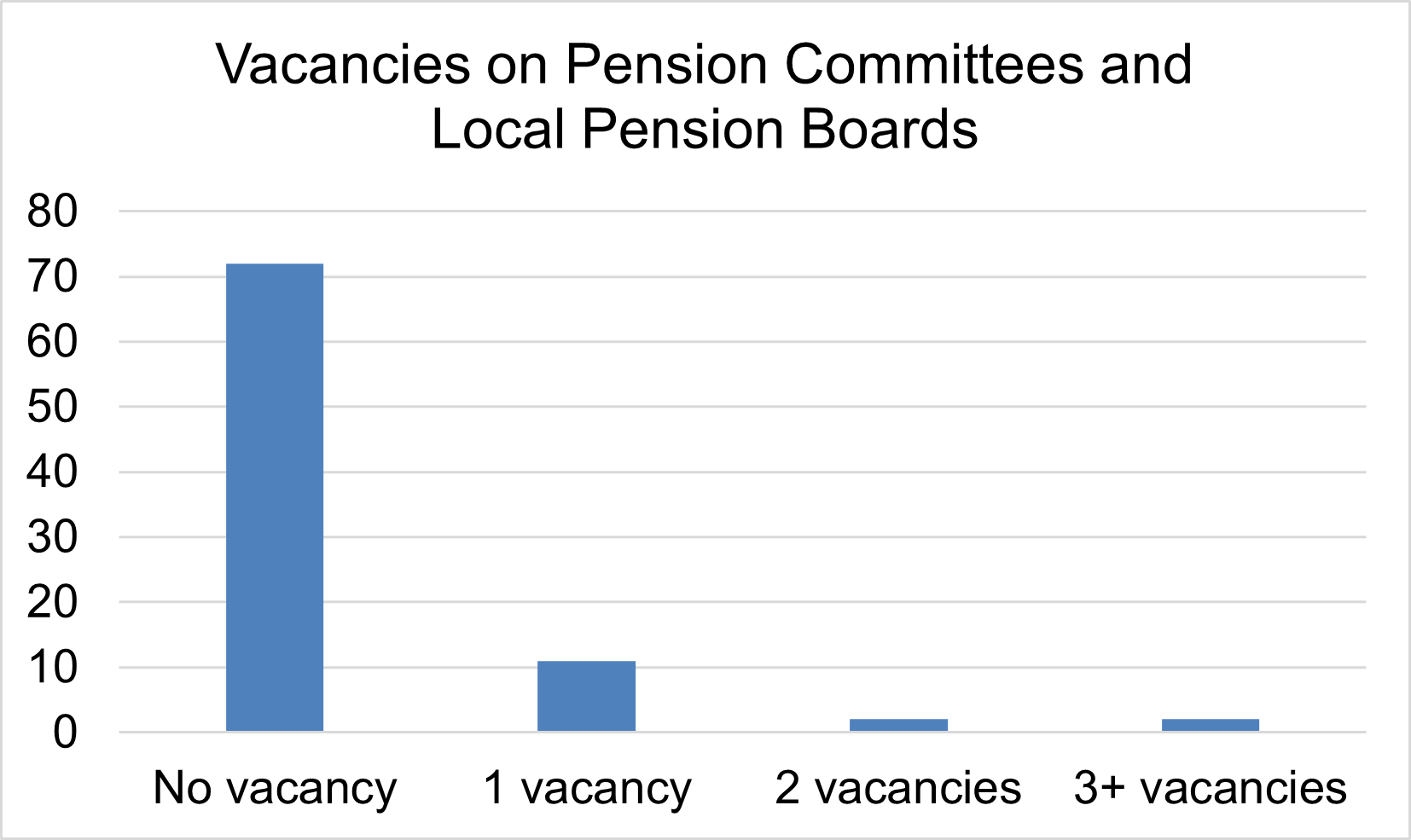
Fifteen pension funds (17 per cent) reported at least one vacancy on either their Pension Committee or Local Pension Board. Four of these funds reported more than one vacancy. Overall, 22 vacancies on Pension Committees and Local Pension Boards were reported across the scheme.
Fifty-five per cent of funds reported on the training undertaken during the year by each individual pension committee or local pension board member. 43 per cent of funds reported general training undertaken, giving information such as topics covered but not which members took this. Two funds did not report on training at all in their annual reports.
Three funds included some equality, diversity and inclusion (EDI) data about their pension committee members in their annual reports. Only one pension fund included EDI data about their local pension board members in their annual report. This data in both cases related to ethnicity and gender.
Seven funds (8 per cent) referenced already having an LGPS Senior Officer in place in their annual report. This is a new role which MHCLG intend to make a statutory requirement in the next scheme year, as part of their Fit for the Future reforms.
Thirty-seven annual reports included or linked to their Local Pension Board Annual Report. Three fund annual reports included or linked to both a Local Pension Board Annual and Pension Committee Annual Report. Forty-seven pension funds did not include either in their annual reports
Eighteen annual reports did not include clear information about the voting rights of members on the Pension Committee and Local Pension Board.
Was this page helpful?