Understanding the LGPS: statutory purpose, pension assets and governance
This statement summarises the statutory purpose, scale and governance of the Local Government Pension Scheme (LGPS) in England and Wales. It explains how the scheme operates, the role of administering authorities and asset pool companies, and why the LGPS should be understood as a funded occupational pension scheme which performs a very different function from a sovereign wealth fund.
Purpose of the LGPS
The LGPS is a statutory, funded public sector pension scheme whose assets are held to meet pension promises to members. It is not a sovereign wealth fund or a state investment vehicle established to pursue government policy objectives. Administering authorities must invest LGPS assets in accordance with statutory and fiduciary duties, with members’ pension outcomes and employer interests as overriding considerations.
LGPS at a glance
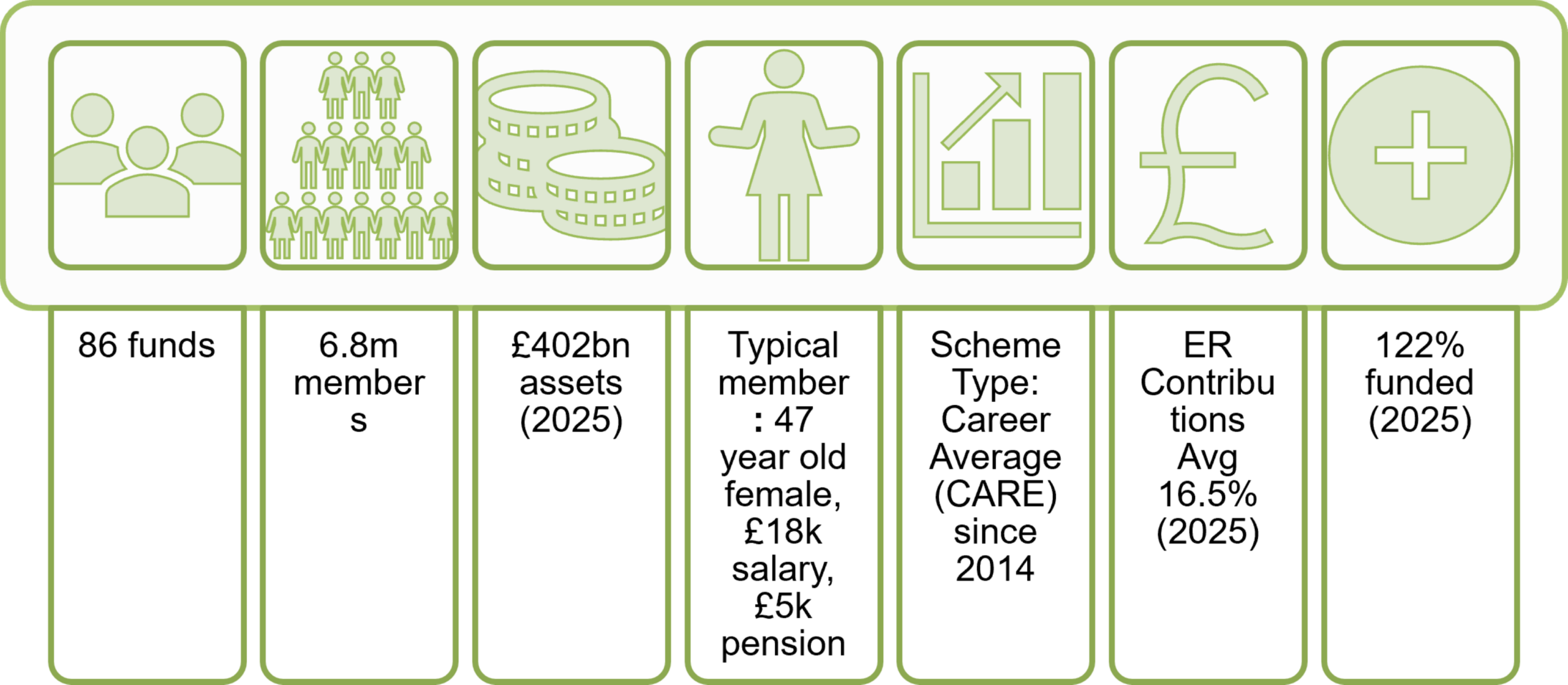
The LGPS in England and Wales is managed by 86 scheme managers, each administered by a designated local authority known as the Administering Authority (AA). The scheme has around 6.8 million members, and as of 31 March 2025 it held £402 billion in assets under management (AUM). More detailed information about the scheme is available in the 2025 Scheme Advisory Board (SAB) Scheme Annual Report.
Employees in local government service have a statutory right to join the LGPS under regulation 3 of the 2013 LGPS Regulations and must be automatically enrolled by their employer.
Although LGPS funds are administered by local authorities, the assets are not part of general local authority revenue and cannot be used to fund day-to-day council services, council tax reductions or unrelated public spending priorities.
In 2014, the LGPS, ahead of equivalent reforms in unfunded public sector pension schemes, moved from a final salary arrangement to a career average (CARE) scheme following the Hutton Review. These reforms were designed to ensure long-term sustainability. Benefit design for public sector pension schemes is set by central government, led by HM Treasury.
Employer contribution rates in the LGPS are determined locally through triennial fund valuations, reflecting each fund’s own funding position, membership profile and employer circumstances. The Scheme Advisory Board’s overview of the 2025 valuations reported a strong aggregate funding position across the scheme, with an overall funding level of 122%. This supported a reduction in the average total employer contribution rate to 16.5%, lower than contribution rates in other public sector schemes[1], while maintaining the principle that rates must remain appropriate to each fund’s long-term funding strategy and risk profile.
The Government introduced public service pension scheme cost control mechanisms to monitor the cost of providing scheme benefits and help manage future spending. These generally apply to benefits accrued since the career average reforms took effect in April 2014. For the LGPS, a parallel SAB cost management process also operates, reflecting the Board’s statutory role and providing additional oversight of scheme costs and their impact on employer contribution rates. The actuarial assumptions for this LGPS-specific process are agreed by the Board. Further information is available on the Board’s Cost Management page.
Social value and retirement adequacy
The LGPS delivers significant social value. A typical member is a 47-year-old woman earning around £18,000 a year who receives an average pension of approximately £5,000 a year. The scheme is also highly efficient and helps many members remain above the threshold for means-tested benefits. Compared with defined contribution (DC) schemes, the LGPS delivers each £1 of retirement income around 50% more cheaply.[2]
The scheme therefore plays an important role in supporting retirement security for lower-paid local government workers.
This matters in the wider pensions adequacy context. Despite reforms over the past quarter century, pensioner poverty remains a persistent issue, with 16% of pensioners (1.9 million out of 12.1 million) living in poverty and around one million experiencing material deprivation.[3] In the wider economy, around half of lower earners contribute only the minimum automatic enrolment level to their pension, while 71% of those earning between £10,000 and £20,000 per year contribute 8% or less of total pay.[4]
Nationally, the Pensions Commission is undertaking a review of long-term retirement adequacy across the pension system, including private sector provision. While many of the challenges prompting that review are less acute within the LGPS, the LGPS demonstrates how a well-governed funded pension scheme can support good retirement outcomes and provide long-term retirement security, particularly for lower-paid workers.
Statutory and fiduciary duties for LGPS administering authorities and asset pool companies
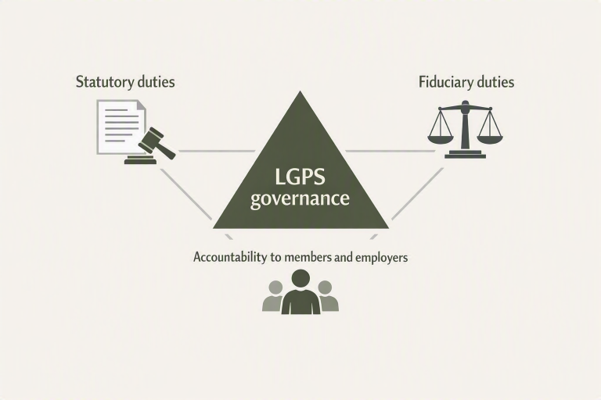
New statutory framework from April 2026
A new statutory framework for the LGPS came into force in April 2026, strengthening governance requirements, including new expectations in relation to senior officer accountability, governance capability and independent oversight, placing asset pooling on a statutory footing and formalising the role of asset pool companies. These reforms are enabled by the Pension Schemes Act 2026, with the detailed governance, pooling and investment requirements set out in secondary legislation and statutory guidance.
During the passage of the Pension Schemes Act 2026, the Government confirmed [5]that it respects the independence of the LGPS and the fiduciary responsibilities of administering authorities and asset pool companies. A proposed power allowing the Secretary of State to direct asset pools to make specific investment decisions was removed from the Bill to provide reassurance on that point. This reinforces the distinction between government’s role in setting the statutory framework and the responsibility of administering authorities and pools to make investment decisions within their statutory and fiduciary duties.
Key legislation and guidance
- Pension Schemes Act 2026
- Local Government Pension Scheme (Pooling, Management and Investment of Funds) Regulations 2026
- Local Government Pension Scheme (Amendment) (Governance) Regulations 2026
- Governance guidance
- Asset pooling guidance
- Investment strategy statement guidance
The reforms clarify the division of responsibilities between administering authorities and asset pools: authorities set objectives and remain accountable for fund outcomes, while pools implement investment strategies and manage assets on their behalf.
Role of administering authorities
Administering authorities remain responsible for managing LGPS funds and setting the investment strategy. In doing so, they must:
- focus on the long-term returns needed to pay pensions when due;
- take account of the timing and value of expected pension payments, including pensions already in payment and benefits that will fall due in future;
- consider financially material factors over the short, medium and long term;
- set the fund’s investment objectives and strategic asset allocation, including its approach to responsible investment, local investment objectives and stewardship;
- ensure local investment and responsible investment priorities sit within, and do not override, the authority’s statutory and fiduciary duties, and
- monitor delivery and hold the asset pool company to account.
Asset pool companies are responsible for implementing the investment strategy and making day-to-day investment decisions. The authority’s role is therefore focused on setting strategy, monitoring delivery and holding the pool to account, rather than directing individual investment decisions.
Role of asset pool companies
Asset pool companies have a formal statutory role in managing LGPS investments on behalf of administering authorities. Their role is to:
- provide investment advice to administering authorities;
- implement the investment strategy set by the administering authority;
- make day-to-day investment management decisions required to manage assets effectively, including buying, holding and selling investments;
- implement responsible investment policies, engagement and voting policies in line with the authority’s strategy and objectives, and
- support cost savings, value for money and competitive long-term investment outcomes through scale.
Asset pools do not set the objectives of the fund. Those remain the responsibility of the administering authority, which oversees the performance of the pool and remains accountable for the pension fund as a whole.
Independent benchmarking of investment costs and performance indicates that asset pools can use their scale to support cost savings, value for money and competitive long-term investment outcomes[6].
How the Scheme Advisory Board supports the LGPS
The Scheme Advisory Board (SAB) helps ensure the LGPS continues to operate effectively as one of the largest funded pension schemes in the world. Bringing together employers, trade unions and other stakeholders, the Board provides independent advice, promotes good practice and helps the scheme respond consistently to policy, governance and investment challenges.
It helps provide the evidence, guidance and coordination needed to support effective decision-making across the scheme in the following ways.
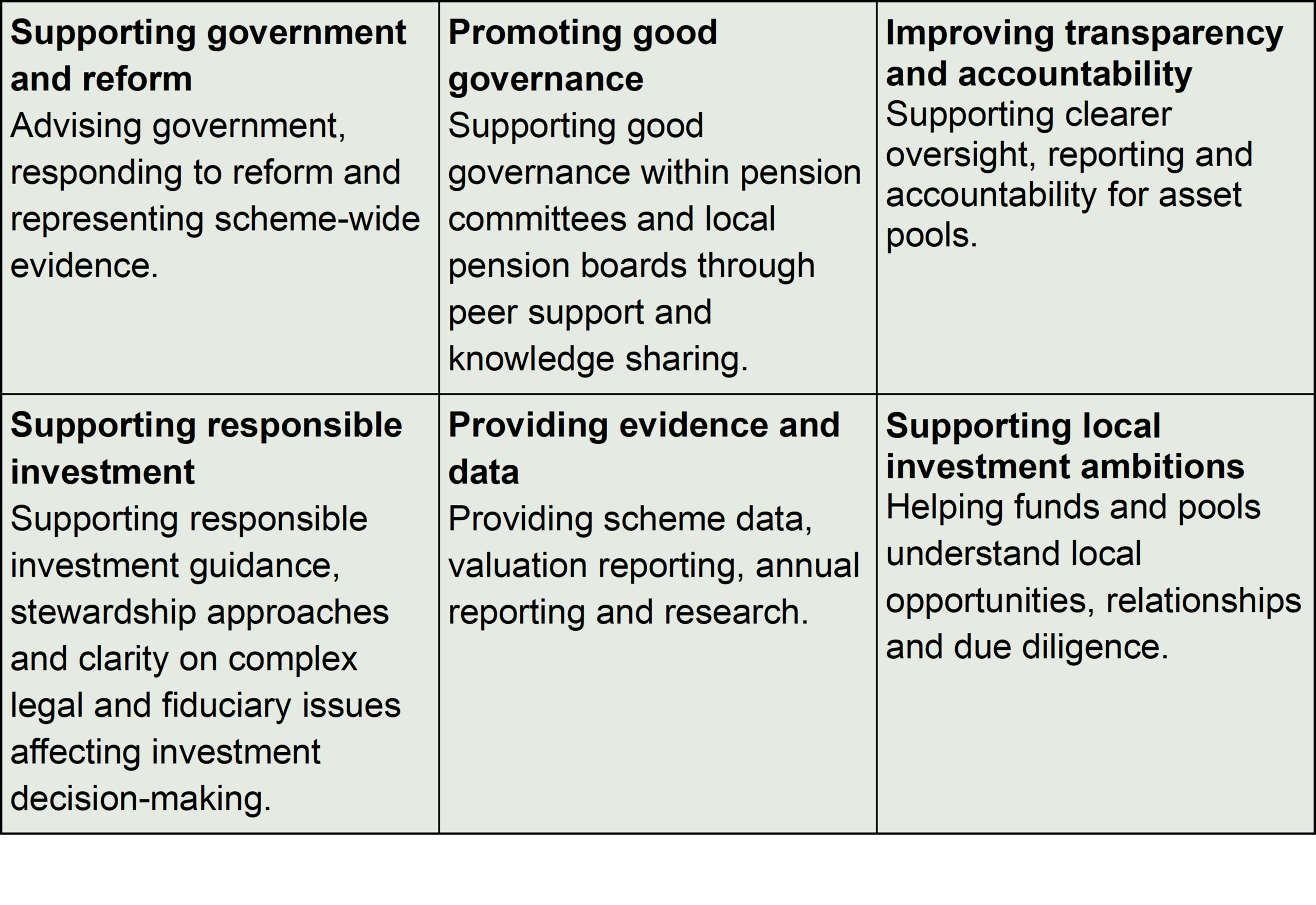
SAB is supporting implementation of the new statutory framework through investment committee working groups agreed at its July 2026 Board meeting. These groups will consider practical approaches to:
- oversight of asset pools;
- common principles for performance reporting;
- implementation of funds’ responsible investment strategies by asset pools, and
- how funds and asset pools can build the knowledge and relationships needed to understand local investment opportunities, including engagement with strategic authorities and due diligence assessments for potential investment projects.
Their work is intended to support consistent reporting, effective oversight and clear accountability as the new arrangements become established.
The Board also acts as an independent voice for the scheme, helping government and stakeholders understand how policy changes affect LGPS funds, employers and members. Recent work has included supporting implementation of the Fit for the Future reforms, helping funds respond to local government reorganisation, promoting collaboration across the sector and highlighting issues such as the gender pensions gap. Together, this work helps ensure that reforms are informed by practical experience and evidence from across the scheme.
Effective pension schemes depend not only on strong governance and clear legal duties, but also on shared learning, evidence and collaboration. SAB helps provide that national perspective, supporting consistency across the scheme while ensuring that administering authorities remain accountable for delivering outcomes for members and employers.
The LGPS as a sustainable long-term pension scheme
The LGPS remains in a strong and sustainable position, supported by robust funding levels, efficient scheme design and an established statutory governance framework. Unlike many private sector defined benefit schemes, it remains open, with ongoing active membership and employer participation. This gives it a longer investment horizon and supports long-term funding and investment planning.
International evidence from the World Bank and OECD suggests that large-scale pension reforms involving pooling, scale, governance and investment capability develop over long time horizons. Experience from Canadian public pension funds and Australian superannuation indicates that such reforms need time to embed before their full impact can be assessed. The current LGPS reforms are still at an early stage of implementation, with the statutory framework having only recently come into force in April 2026.
The enduring purpose of the LGPS
The LGPS is one of the largest funded pension schemes in the world, providing retirement benefits to millions of current and former local government employees. Its assets are held to pay pensions, its governance framework is designed to protect the interests of members and employers, and its investment arrangements support benefits that will be paid over many decades. While the scheme continues to evolve in response to reforms and changing expectations, its core purpose remains unchanged: to deliver the pension benefits promised to members efficiently, sustainably and in accordance with its statutory and fiduciary duties.
[1] The unfunded public sector DB schemes rates vary from 23.7% (NHS), 28.6% (Teachers), 36.2% (Fire), and 38.7% (Police)
[2] Better-Bang-for-the-Buck-3.0-F11.pdf
[3] The Second Pensions Commission – Pensions 2050: Evidence and Future Priorities – Interim Report para 1.34
[4] The Second Pensions Commission – Pensions 2050: Evidence and Future Priorities – Interim Report para 3.36
Was this page helpful?