Understanding the LGPS: statutory purpose, pension assets and governance
This statement summarises the statutory purpose, scale and governance of the Local Government Pension Scheme (LGPS) in England and Wales. It explains how the scheme operates, the role of administering authorities and asset pool companies, and why the LGPS should be understood as a funded occupational pension scheme which performs a very different function from a sovereign wealth fund.
Purpose of the LGPS
The LGPS is a statutory, funded public sector pension scheme whose assets are held to meet pension promises to members. It is not a sovereign wealth fund or a state investment vehicle established to pursue government policy objectives. Administering authorities must invest LGPS assets in accordance with statutory and fiduciary duties, with members’ pension outcomes and employer interests as overriding considerations.
LGPS at a glance
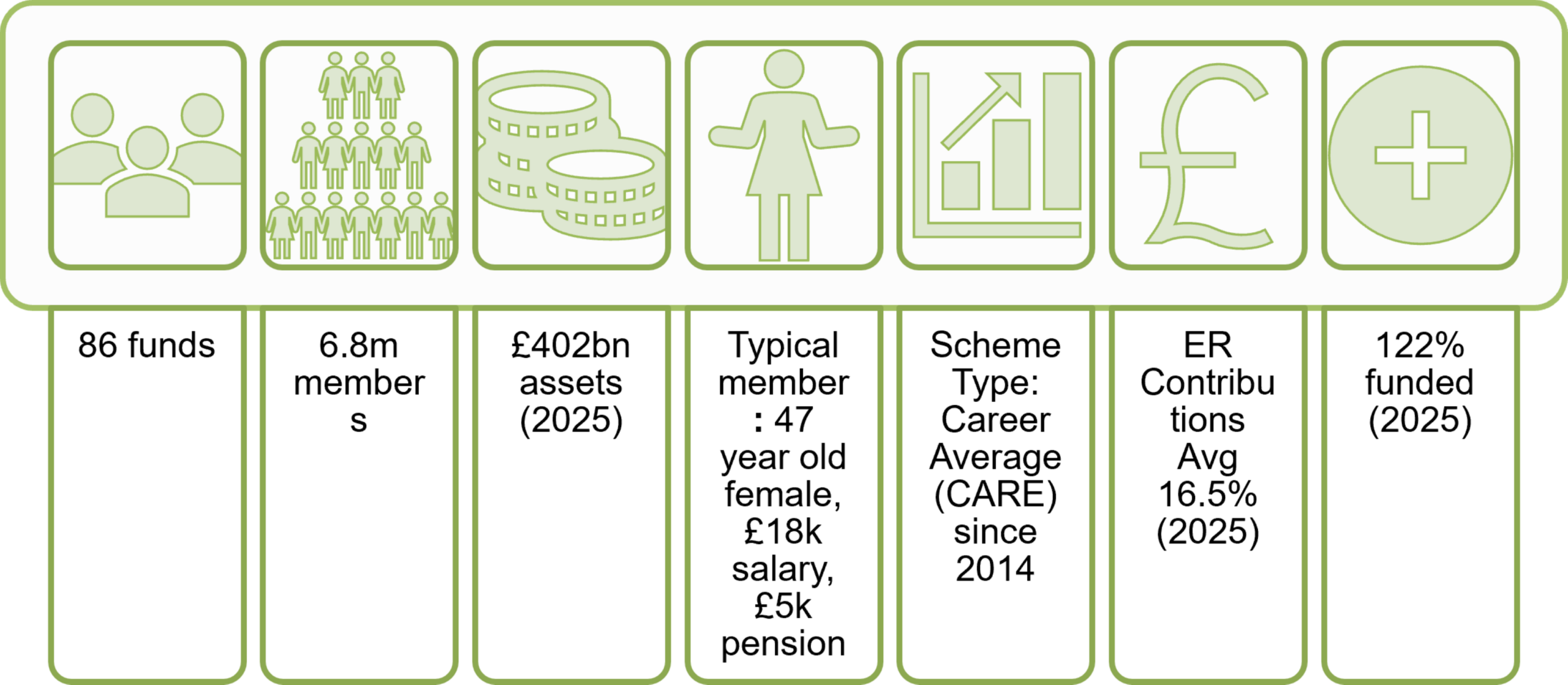
The LGPS in England and Wales is managed by 86 scheme managers, each administered by a designated local authority known as the Administering Authority (AA). The scheme has around 6.8 million members, and as of 31 March 2025 it held £402 billion in assets under management (AUM). More detailed information about the scheme is available in the 2025 Scheme Advisory Board (SAB) Scheme Annual Report.
Employees in local government service have a statutory right to join the LGPS under regulation 3 of the 2013 LGPS Regulations and must be automatically enrolled by their employer.
Although LGPS funds are administered by local authorities, the assets are not part of general local authority revenue and cannot be used to fund day-to-day council services, council tax reductions or unrelated public spending priorities.
In 2014, the LGPS, ahead of equivalent reforms in unfunded public sector pension schemes, moved from a final salary arrangement to a career average (CARE) scheme following the Hutton Review. These reforms were designed to ensure long-term sustainability. Benefit design for public sector pension schemes is set by central government, led by HM Treasury.
Employer contribution rates in the LGPS are determined locally through triennial fund valuations, reflecting each fund’s own funding position, membership profile and employer circumstances. The Scheme Advisory Board’s overview of the 2025 valuations reported a strong aggregate funding position across the scheme, with an overall funding level of 122%. This supported a reduction in the average total employer contribution rate to 16.5%, lower than contribution rates in other public sector schemes[1], while maintaining the principle that rates must remain appropriate to each fund’s long-term funding strategy and risk profile.
The Government introduced public service pension scheme cost control mechanisms to monitor the cost of providing scheme benefits and help manage future spending. These generally apply to benefits accrued since the career average reforms took effect in April 2014. For the LGPS, a parallel SAB cost management process also operates, reflecting the Board’s statutory role and providing additional oversight of scheme costs and their impact on employer contribution rates. The actuarial assumptions for this LGPS-specific process are agreed by the Board. Further information is available on the Board’s Cost Management page.
Social value and retirement adequacy
The LGPS delivers significant social value. A typical member is a 47-year-old woman earning around £18,000 a year who receives an average pension of approximately £5,000 a year. The scheme is also highly efficient and helps many members remain above the threshold for means-tested benefits. Compared with defined contribution (DC) schemes, the LGPS delivers each £1 of retirement income around 50% more cheaply.[2]
The scheme therefore plays an important role in supporting retirement security for lower-paid local government workers.
This matters in the wider pensions adequacy context. Despite reforms over the past quarter century, pensioner poverty remains a persistent issue, with 16% of pensioners (1.9 million out of 12.1 million) living in poverty and around one million experiencing material deprivation.[3] In the wider economy, around half of lower earners contribute only the minimum automatic enrolment level to their pension, while 71% of those earning between £10,000 and £20,000 per year contribute 8% or less of total pay.[4]
Nationally, the Pensions Commission is undertaking a review of long-term retirement adequacy across the pension system, including private sector provision. While many of the challenges prompting that review are less acute within the LGPS, the LGPS demonstrates how a well-governed funded pension scheme can support good retirement outcomes and provide long-term retirement security, particularly for lower-paid workers.
Statutory and fiduciary duties for LGPS administering authorities and asset pool companies
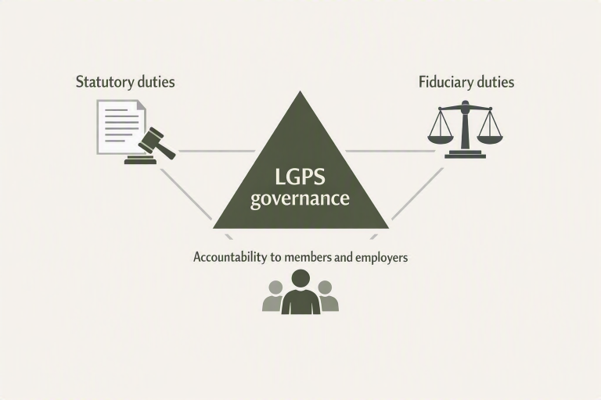
New statutory framework from April 2026
A new statutory framework for the LGPS came into force in April 2026, strengthening governance requirements, including new expectations in relation to senior officer accountability, governance capability and independent oversight, placing asset pooling on a statutory footing and formalising the role of asset pool companies. These reforms are enabled by the Pension Schemes Act 2026, with the detailed governance, pooling and investment requirements set out in secondary legislation and statutory guidance.
During the passage of the Pension Schemes Act 2026, the Government confirmed [5]that it respects the independence of the LGPS and the fiduciary responsibilities of administering authorities and asset pool companies. A proposed power allowing the Secretary of State to direct asset pools to make specific investment decisions was removed from the Bill to provide reassurance on that point. This reinforces the distinction between government’s role in setting the statutory framework and the responsibility of administering authorities and pools to make investment decisions within their statutory and fiduciary duties.
Key legislation and guidance
- Pension Schemes Act 2026
- Local Government Pension Scheme (Pooling, Management and Investment of Funds) Regulations 2026
- Local Government Pension Scheme (Amendment) (Governance) Regulations 2026
- Governance guidance
- Asset pooling guidance
- Investment strategy statement guidance
The reforms clarify the division of responsibilities between administering authorities and asset pools: authorities set objectives and remain accountable for fund outcomes, while pools implement investment strategies and manage assets on their behalf.
Role of administering authorities
Administering authorities remain responsible for managing LGPS funds and setting the investment strategy. In doing so, they must:
- focus on the long-term returns needed to pay pensions when due;
- take account of the timing and value of expected pension payments, including pensions already in payment and benefits that will fall due in future;
- consider financially material factors over the short, medium and long term;
- set the fund’s investment objectives and strategic asset allocation, including its approach to responsible investment, local investment objectives and stewardship;
- ensure local investment and responsible investment priorities sit within, and do not override, the authority’s statutory and fiduciary duties, and
- monitor delivery and hold the asset pool company to account.
Asset pool companies are responsible for implementing the investment strategy and making day-to-day investment decisions. The authority’s role is therefore focused on setting strategy, monitoring delivery and holding the pool to account, rather than directing individual investment decisions.
Role of asset pool companies
Asset pool companies have a formal statutory role in managing LGPS investments on behalf of administering authorities. Their role is to:
- provide investment advice to administering authorities;
- implement the investment strategy set by the administering authority;
- make day-to-day investment management decisions required to manage assets effectively, including buying, holding and selling investments;
- implement responsible investment policies, engagement and voting policies in line with the authority’s strategy and objectives, and
- support cost savings, value for money and competitive long-term investment outcomes through scale.
Asset pools do not set the objectives of the fund. Those remain the responsibility of the administering authority, which oversees the performance of the pool and remains accountable for the pension fund as a whole.
Independent benchmarking of investment costs and performance indicates that asset pools can use their scale to support cost savings, value for money and competitive long-term investment outcomes[6].
How the Scheme Advisory Board supports the LGPS
The Scheme Advisory Board (SAB) helps ensure the LGPS continues to operate effectively as one of the largest funded pension schemes in the world. Bringing together employers, trade unions and other stakeholders, the Board provides independent advice, promotes good practice and helps the scheme respond consistently to policy, governance and investment challenges.
It helps provide the evidence, guidance and coordination needed to support effective decision-making across the scheme in the following ways.
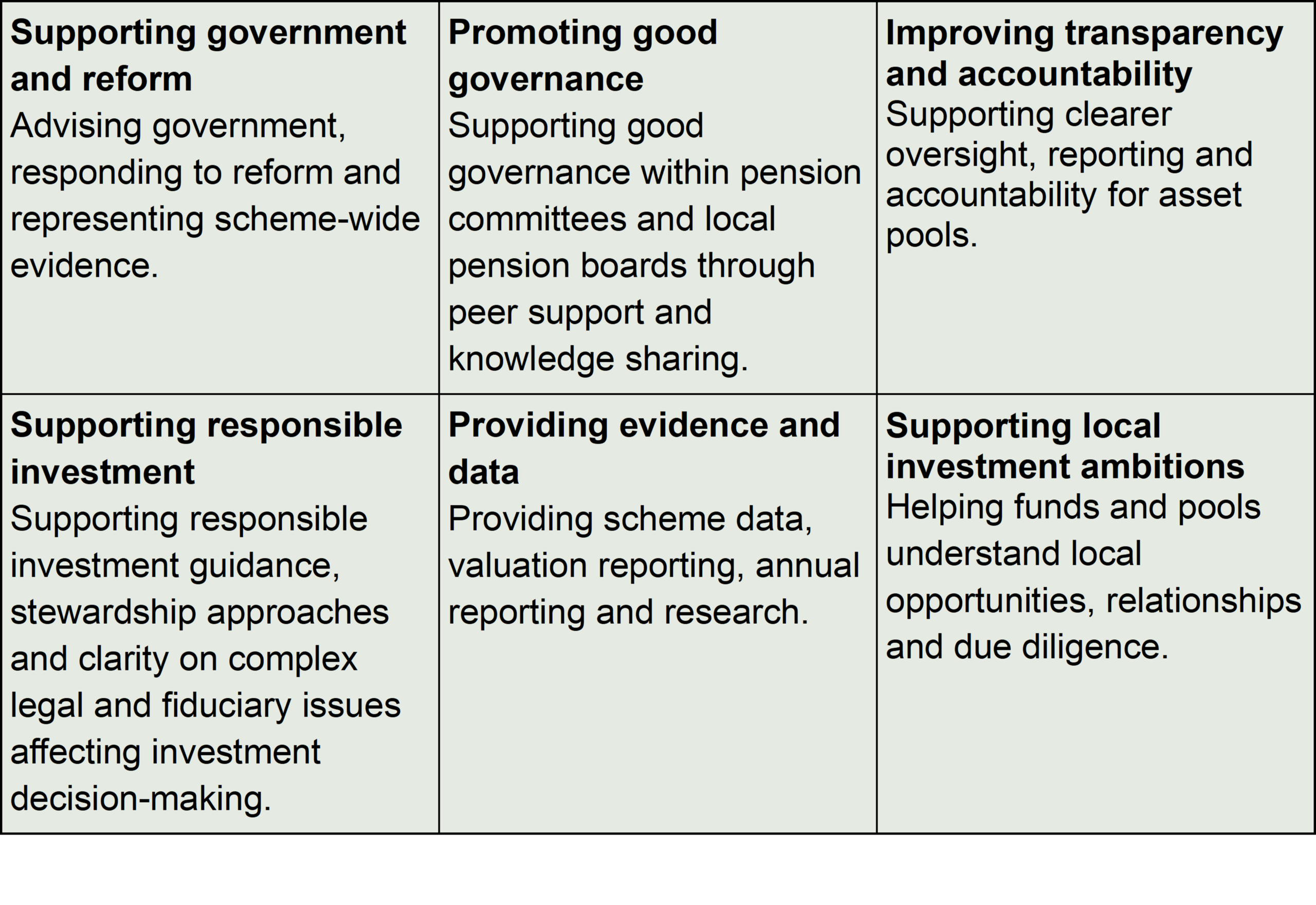
SAB is supporting implementation of the new statutory framework through investment committee working groups agreed at its July 2026 Board meeting. These groups will consider practical approaches to:
- oversight of asset pools;
- common principles for performance reporting;
- implementation of funds’ responsible investment strategies by asset pools, and
- how funds and asset pools can build the knowledge and relationships needed to understand local investment opportunities, including engagement with strategic authorities and due diligence assessments for potential investment projects.
Their work is intended to support consistent reporting, effective oversight and clear accountability as the new arrangements become established.
The Board also acts as an independent voice for the scheme, helping government and stakeholders understand how policy changes affect LGPS funds, employers and members. Recent work has included supporting implementation of the Fit for the Future reforms, helping funds respond to local government reorganisation, promoting collaboration across the sector and highlighting issues such as the gender pensions gap. Together, this work helps ensure that reforms are informed by practical experience and evidence from across the scheme.
Effective pension schemes depend not only on strong governance and clear legal duties, but also on shared learning, evidence and collaboration. SAB helps provide that national perspective, supporting consistency across the scheme while ensuring that administering authorities remain accountable for delivering outcomes for members and employers.
The LGPS as a sustainable long-term pension scheme
The LGPS remains in a strong and sustainable position, supported by robust funding levels, efficient scheme design and an established statutory governance framework. Unlike many private sector defined benefit schemes, it remains open, with ongoing active membership and employer participation. This gives it a longer investment horizon and supports long-term funding and investment planning.
International evidence from the World Bank and OECD suggests that large-scale pension reforms involving pooling, scale, governance and investment capability develop over long time horizons. Experience from Canadian public pension funds and Australian superannuation indicates that such reforms need time to embed before their full impact can be assessed. The current LGPS reforms are still at an early stage of implementation, with the statutory framework having only recently come into force in April 2026.
The enduring purpose of the LGPS
The LGPS is one of the largest funded pension schemes in the world, providing retirement benefits to millions of current and former local government employees. Its assets are held to pay pensions, its governance framework is designed to protect the interests of members and employers, and its investment arrangements support benefits that will be paid over many decades. While the scheme continues to evolve in response to reforms and changing expectations, its core purpose remains unchanged: to deliver the pension benefits promised to members efficiently, sustainably and in accordance with its statutory and fiduciary duties.
[1] The unfunded public sector DB schemes rates vary from 23.7% (NHS), 28.6% (Teachers), 36.2% (Fire), and 38.7% (Police)
[2] Better-Bang-for-the-Buck-3.0-F11.pdf
[3] The Second Pensions Commission – Pensions 2050: Evidence and Future Priorities – Interim Report para 1.34
[4] The Second Pensions Commission – Pensions 2050: Evidence and Future Priorities – Interim Report para 3.36
[5] 10.02.26_PSB_Committee_LGPS_Letter.pdf
[6] UK: The case for pooling | Country Report | IPE
The Board is aware that LGPS administering authorities (AAs) are receiving further correspondence from the Palestine Solidarity Campaign (PSC) following the response to a letter from the previous Minister on the question of LGPS legal duties and international human rights law. That letter was in response to an invitation by the Board’s Chair, Cllr Roger Phillips OBE, to address the legal arguments being put forward by the PSC.
The Board has also received correspondence from the UK Lawyers for Israel setting out an alternative legal view.
The issue raised is one that AAs must consider carefully. The Board is in no doubt that AAs are endeavouring to follow the law, their responsible investment beliefs and their fiduciary duty. However, the Board is concerned that individual funds may be expected to shoulder significant legal, financial and reputational risk arising from uncertainty over the legal position. It is unreasonable to expect individual AAs to navigate a novel and contested legal question without greater certainty as to the basis on which those judgments are expected to be made.
While investment decisions are implemented through LGPS pools, it is the responsibility of administering authorities to set their investment strategy, including their responsible investment policy and they remain accountable for ensuring those policies are carried out in accordance with the law and their fiduciary duties.
The earlier reply from the previous Minister simply did not address the key point about whether the government accepts the legal arguments about the AA function being sufficiently connected to the state to require it to have regard to international human rights law duties engaged by the ongoing conflict in Gaza. The Board does not want the UK Government to try and set responsible investment policy. Rather, the Board believes that AAs are entitled to understand the Government’s position on this specific legal question, so that they can take their own decisions with a clearer understanding of the legal context in which those decisions are being made.
The Board has today written to the new Local Government Minister, Jim McMahon OBE MP, to seek an urgent meeting on this question.
Legal advice remains one of the options under consideration by the Board, as well as by individual funds or pools. However, advice may differ between sources and no individual KC’s opinion is likely on its own to resolve the matter conclusively.
In the meantime, the Board’s advice to AAs is to consider the issues raised carefully and ensure they are clear about the rationale for their decisions. Authorities should continue to set and follow their responsible investment policies in line with their understanding of the fiduciary duty and should not feel pressured into changing course solely because legal action is being contemplated or threatened.
AAs may also wish to note that the Board is also in the process of drawing up some new guidance on setting a fund RI policy.
Cllr Roger Phillips OBE, Chair of the Board and George Georgiou, GMB National Pensions Organiser and Vice-Chair of the Board.
The Scheme Advisory Board has published an overview of the triennial valuation and a detailed report on the results for 2025.
The Scheme Advisory Board welcomes the publication of the “Fit for the Future” statutory guidance documents made under the Pension Schemes Act 2026 and the associated changes to the LGPS regulations which take effect from 30 June 2026.
The guidance provides the much needed clarity that administering authorities (AAs) have been waiting for to implement this significant package of reforms. In particular, the Board welcomes the continued focus on governance, reflecting many of the principles set out in its 2021 Good Governance recommendations.
The guidance explains how the Government expects the new Independent Person and Senior LGPS Officer roles to operate, both independently and in partnership. These new roles represent a significant development in governance, and the Board recognises the efforts funds are making to get these roles in place.
At the same time, funds will need to review and develop a range of policies and processes to meet the new requirements. The governance guidance sets out the requirements for the new Independent Governance Review (IGR). The Board recognises that there will be significant interest across the LGPS community in understanding how the first IGRs will operate in practice, including emerging approaches to implementation. To support this, we are currently exploring the development of a dedicated event that would provide an opportunity to share insights and facilitate discussion on how AA’s can effectively approach their first IGR.
The requirement for administering authorities to maintain an Administration Strategy is a welcome development which recognises the importance of pensions administration in delivering good outcomes for members and employers. The Board looks forward to further guidance to support funds in developing and implementing these strategies.
The publication of pooling guidance is also a significant milestone, providing funds with an overdue framework for implementing the Government’s chosen asset pooling model. The Board recognises that there were different views as to whether this was the right model and that implementation has presented challenges for some funds. However, now that this has been set out in legislation the task before us is to make it work as well as possible. And there is still much of the detail to be fleshed out, particularly around oversight and governance, which the Board intends to support funds and pools in achieving successful outcomes.
The updated guidance on Investment Strategy Statements (ISSs) is particularly important as funds prepare to update their statements ahead of the March 2027 deadline.
We recognise that while this is not the timetable the Board would have preferred, the final guidance represents a significant improvement in both content and clarity compared with the versions consulted on over the Christmas period.
The Board has worked extensively throughout the development of the regulations and guidance to ensure that MHCLG officials understood the opportunities and practical challenges these reforms present, We are pleased that officials have remained open to engagement and feedback from the sector and believe this collaborative approach has contributed to improvements in the guidance. We will continue to monitor implementation closely and are ready to provide additional support for AAs. We are already considering what additional guidance, events and support may be helpful in navigating these changes. Please do get in touch with the secretariat team if you have any suggestions.
Yours Sincerely,
Cllr Roger Phillips, Chair of the Board and Clair Alcock, Board Secretary and Head of Pensions, LGA
content 2
content
Burges Salmon legal advice on pooling governance and conflicts of interests
The Board commissioned high-level advice from the legal firm Burges Salmon to help administering authorities consider practical ways of working that were consistent with the government’s Fit for the Future proposals on pooling while managing conflicts of interest. We asked that the legal advice consider the different pooling governance models currently being operated by LGPS pools and wider practice in comparable schemes. It is intended that this will help inform the development of wider pooling governance guidance that might be issued, in so far as that addresses the issue of conflicts of interest. The advice has now been received and has also been seen and discussed by the Board and its Investment Committee.
Pension Fund |
Authority |
PSPA 6(a) |
PSPA 6(b) |
PSPA 6(c) |
| Avon Pension Fund | Bath & North East Somerset Council | Yes | No | Yes |
| Barking and Dagenham Pension Fund | London Borough of Barking and Dagenham | Yes | No | Yes |
| Barnet Pension Fund | London Borough of Barnet | Yes | No | Yes |
| Bedfordshire Pension Fund | Bedford Borough Council | Yes | Yes | Yes |
| Berkshire Pension Fund | Royal Borough of Windsor and Maidenhead | Yes | Yes | Yes |
| Bexley Pension Fund | London Borough of Bexley | Yes | Yes | Yes |
| Brent Pension Fund | London Borough of Brent | Yes | No | Yes |
| Bromley Pension Fund | London Borough of Bromley | Yes | No | Yes |
| Buckinghamshire Pension Fund | Buckinghamshire County Council | Yes | Yes | Yes |
| Cambridgeshire Pension Fund | Cambridgeshire County Council | Yes | No | Yes |
| Camden Pension Fund | London Borough of Camden | Yes | Yes | Yes |
| Cardiff Pension Fund | City of Cardiff Council | No | No | Yes |
| Cheshire Pension Fund | Cheshire West and Chester Council | Yes | Yes | Yes |
| City of London Corporation Pension Fund | City of London Corporation | No | No | Yes |
| City of Westminster Pension Fund | Westminster City Council | Yes | Yes | Yes |
| Clwyd Pension Fund | Flintshire County Council | No | Yes | Yes |
| Cornwall Pension Fund | Cornwall Council | Yes | Yes | Yes |
| Croydon Pension Fund | London Borough of Croydon | Yes | Yes | Yes |
| Cumbria Pension Fund | Cumbria County Council | Yes | Yes | Yes |
| Derbyshire Pension Fund | Derbyshire County Council | Partial | Partial | Yes |
| Devon Pension Fund | Devon County Council | Yes | Yes | Yes |
| Dorset Pension Fund | Dorset County Council | No | No | Yes |
| Durham Pension Fund | Durham County Council | Yes | Yes | Yes |
| Dyfed Pension Fund | Carmarthenshire County Council | Yes | Yes | Yes |
| Ealing Pension Fund | London Borough of Ealing | No | No | No |
| East Riding Pension Fund | East Riding of Yorkshire Council | Yes | Yes | Yes |
| East Sussex Pension Fund | East Sussex County Council | Yes | Yes | Yes |
| Enfield Pension Fund | London Borough of Enfield | Yes | No | No |
| Environment Agency – active Pension Fund | The Environment Agency | Yes | Yes | Yes |
| Environment Agency – closed Pension Fund | The Environment Agency | No | No | No |
| Essex Pension Fund | Essex County Council | Yes | Yes | Yes |
| Gloucestershire Pension Fund | Gloucestershire County Council | Yes | Yes | Yes |
| Greater Gwent (Torfaen) Pension Fund | Torfaen County Borough Council | Yes | Yes | Yes |
| Greater Manchester Pension Fund | Tameside Metropolitan Borough Council | Yes | Yes | Yes |
| Greenwich Pension Fund | Royal Borough of Greenwich | Yes | Yes | Yes |
| Gwynedd Pension Fund | Gwynedd Council | Yes | Yes | Yes |
| Hackney Pension Fund | London Borough of Hackney | Yes | No | Yes |
| Hammersmith and Fulham Pension Fund | London Borough of Hammersmith and Fulham | Partial | Yes | Yes |
| Hampshire Pension Fund | Hampshire County Council | Yes | Yes | Yes |
| Haringey Pension Fund | London Borough of Haringey | No | No | Yes |
| Harrow Pension Fund | London Borough of Harrow | Yes | Yes | Yes |
| Havering Pension Fund | London Borough of Havering | Yes | Yes | Yes |
| Hertfordshire Pension Fund | Hertfordshire County Council | No | No | Yes |
| Hillingdon Pension Fund | London Borough of Hillingdon | Yes | Yes | Yes |
| Hounslow Pension Fund | London Borough of Hounslow | Yes | Yes | Yes |
| Isle of Wight Pension Fund | Isle of Wight Council | Yes | Yes | Yes |
| Islington Pension Fund | London Borough of Islington | Yes | Yes | Yes |
| Kensington and Chelsea Pension Fund | Royal Borough of Kensington and Chelsea | Yes | Partial | Yes |
| Kent Pension Fund | Kent County Council | Yes | Yes | Yes |
| Kingston upon Thames Pension Fund | Royal Borough of Kingston upon Thames | Yes | Yes | Yes |
| Lambeth Pension Fund | London Borough of Lambeth | Yes | Yes | Yes |
| Lancashire Pension Fund | Lancashire County Council | Yes | Yes | Yes |
| Leicestershire Pension Fund | Leicestershire County Council | Yes | Yes | Yes |
| Lewisham Pension Fund | London Borough of Lewisham | Yes | Yes | Yes |
| Lincolnshire Pension Fund | Lincolnshire County Council | Yes | Yes | Yes |
| London Pensions Fund Authority Pension Fund | London Pensions Fund Authority | Yes | Yes | Yes |
| Merseyside Pension Fund | Wirral Council | Yes | Yes | Yes |
| Merton Pension Fund | London Borough of Merton | No | No | Yes |
| Newham Pension Fund | London Borough of Newham | No | No | Yes |
| Norfolk Pension Fund | Norfolk County Council | Yes | Yes | Yes |
| North Yorkshire Pension Fund | North Yorkshire County Council | Yes | Yes | Yes |
| Northamptonshire Pension Fund | Northamptonshire County Council | Partial | No | Yes |
| Northumberland Pension Fund | Northumberland County Council | Yes | Yes | Yes |
| Nottinghamshire Pension Fund | Nottinghamshire County Council | No | No | Yes |
| Oxfordshire Pension Fund | Oxfordshire County Council | No | No | Yes |
| Powys Pension Fund | Powys County Council | No | No | Yes |
| Redbridge Pension Fund | London Borough of Redbridge | Yes | Yes | Yes |
| Rhondda Cynon Taf Pension Fund | Rhondda Cynon Taf County Borough Council | Yes | Yes | Yes |
| Richmond Pension Fund | London Borough of Richmond upon Thames | Yes | Yes | Yes |
| Shropshire Pension Fund | Shropshire Council | Yes | Yes | Yes |
| Somerset Pension Fund | Somerset County Council | Yes | No | Yes |
| South Yorkshire Pension Fund | South Yorkshire Pensions Authority | Yes | Yes | Yes |
| South Yorkshire Passenger Transport Pension Fund | South Yorkshire Integrated Transport Authority | Yes | Yes | Yes |
| Southwark Pension Fund | London Borough of Southwark | Yes | Yes | Yes |
| Staffordshire Pension Fund | Staffordshire County Council | Yes | Yes | Yes |
| Suffolk Pension Fund | Suffolk County Council | Yes | Yes | Yes |
| Surrey Pension Fund | Surrey County Council | Yes | Yes | Yes |
| Sutton Pension Fund | London Borough of Sutton | Yes | Yes | Yes |
| Swansea Pension Fund | City & County of Swansea | Yes | Yes | Yes |
| Teesside Pension Fund | Middlesbrough Council | Yes | Yes | Yes |
| Tower Hamlets Pension Fund | London Borough of Tower Hamlets | Yes | Yes | Yes |
| Tyne and Wear Pension Fund | South Tyneside Council | Yes | Yes | Yes |
| Waltham Forest Pension Fund | London Borough of Waltham Forest | No | No | Yes |
| Wandsworth Pension Fund | London Borough of Wandsworth | Yes | No | No |
| Warwickshire Pension Fund | Warwickshire County Council | Yes | Yes | Yes |
| West Midlands Pension Fund | Wolverhampton City Council | Yes | Yes | Yes |
| West Midlands Passenger Transport Pension Fund | West Midlands Integrated Transport Authority | Yes | Yes | Yes |
| West Sussex Pension Fund | West Sussex County Council | Yes | Yes | Yes |
| West Yorkshire Pension Fund | City of Bradford Metropolitan District Council | No | No | Yes |
| Wiltshire Pension Fund | Wiltshire Council | Yes | Yes | Yes |
| Worcestershire Pension Fund | Worcestershire County Council | Yes | No | Yes |
Further to the Board’s statement of the 27th July 2020 on the status of local pension board meetings during covid restrictions, the emergency legislation that the government introduced to allow section 101 committees to meet remotely has not been renewed and ceased to have effect from the 6th May. This has led to some confusion over whether local pension boards should follow suit and return to face to face meetings.
The SAB wishes to make it clear that the position set out in the earlier statement remains unchanged. Legal opinion obtained by the Board in January 2015 concluded that local pension boards are not local authority committees and are not therefore subject to the same legal requirements and conventions as, say, an LGPS pensions committee. The legal requirement for section 101 committees to return to face to face meetings does not therefore apply to local pension boards who may continue to meet remotely, face to face or a combination of both as agreed locally.
Administering authorities who have established a combined committee and local pension board under Regulation 106(2) of the 2013 Regulations may wish to seek their own legal advice on how future meetings should be conducted.
Following concerns raised at a recent Local Pension Board workshop the following statement on the position of local pension boards meeting during the covid-19 emergency has been agreed:- SAB statement on Local Pension Board meeting cancellations (pdf 1 page, 60Kb)
Was this page helpful?